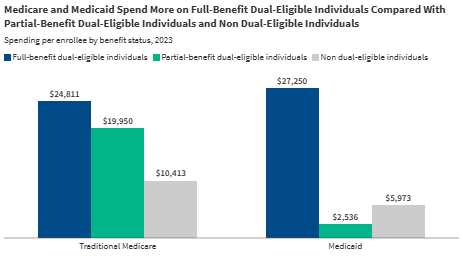
There are approximately 12 million people enrolled in both Medicare and Medicaid, who are also known as dual-eligible individuals. Compared with people who are only covered by Medicare or Medicaid, this group is more likely to report being in fair or poor health and require assistance with activities of daily living and often experiences more fragmented or disjointed health care on account of having two sources of coverage.
For dual-eligible individuals, Medicare is the primary payer and covers medical and post-acute care, while Medicaid wraps around Medicare coverage by paying Medicare premiums and in most cases, cost-sharing. Among the approximately 12 million dual-eligible individuals, 8.6 million are “full-benefit” dual-eligible individuals, meaning they are eligible for Medicaid benefits that are not covered by Medicare, including long-term care, vision, and dental. The remaining 3.5 million dual-eligible individuals are “partial-benefit” dual-eligible individuals, who are eligible only for assistance with Medicare premiums, and in many cases, cost sharing through the Medicare Savings Programs (see Appendix, “How do Medicare Beneficiaries Become Eligible for Medicaid?”).