Why does the stability of the PDP market matter?
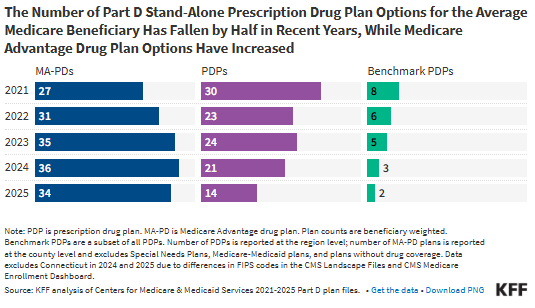
For Medicare beneficiaries who are enrolled in traditional Medicare, which is just under half of all people with Medicare, getting Medicare Part D prescription drug coverage means enrolling in a stand-alone PDP. For Medicare beneficiaries who qualify for the Part D Low-Income Subsidy (LIS), enrolling in certain PDPs provides the only guaranteed option for premium-free drug coverage and lower cost sharing. In recent years, the overall number of PDPs has declined, with the number of PDPs available to the average beneficiary decreasing from 30 in 2021 to 14 in 2025 (Figure 1). The number of premium-free (“benchmark”) plans for LIS enrollees is even lower and decreased from 8 benchmark PDPs in 2021 to 2 in 2025. Over this period, the average number of Medicare Advantage drug plans (MA-PDs) increased from 27 to 34. ARTICLE